

Printed documents still carry privacy risk in hybrid work. Under Canada’s federal privacy law (PIPEDA), organizations should destroy, erase, or anonymize personal information once it’s no longer required and implement procedures to govern destruction.
Secure shredding remains a simple, auditable control for homes and small offices. (Source: PIPEDA Principle 4.5.4, Accessed: 2025-12. Justice Laws) The Office of the Privacy Commissioner (OPC) echoes this: dispose of personal information when it no longer fulfills its purpose, using methods that prevent privacy breaches (e.g., securely shredding paper files).
P-Levels 101: From Strip-Cut to Super Micro-Cut Under DIN 66399
Paper shredders are classified from P-1 to P-7. Higher numbers mean smaller particles and greater resistance to reassembly:
- P-1/P-2 (strip-cut): basic privacy—receipts, junk mail.
- P-3/P-4 (cross-/micro-cut): everyday confidential documents for homes/SOHO; P-4 is often the practical default for sensitive office paperwork.
- P-5 (super micro-cut): higher sensitivity (client IDs, partial financials) with smaller particles; tradeoff is throughput.
- P-6/P-7: specialized, high-security contexts; overkill for most homes.
Run Time vs Cool-Down: Understanding Shredder Duty Cycles
Compact shredders protect motors with duty cycles (short continuous run followed by cooldown), while higher-end office units extend continuous run time and add thermal safeguards. Plan workflows around duty cycles to reflect real throughput. For terminology and process context, see the ISO/IEC 21964 series.
Top Shredders 2025 (Canada): Home Office and SOHO Recommendations
Budget Portable Shredder for Light Use:5-Sheet Strip Cut Shredder with Extendable Arm

A 5-sheet strip-cut head with an extendable arm (fits bins up to ~35.5 cm/14″) so you can use your own wastebasket. Auto start/stop, thermal/overheat protection, and forward/reverse assist with jams; up to 3.8 m/min speed. Best for low-sensitivity material with minimal footprint.
Quiet 8-Sheet Shredder for Homes & Small Offices
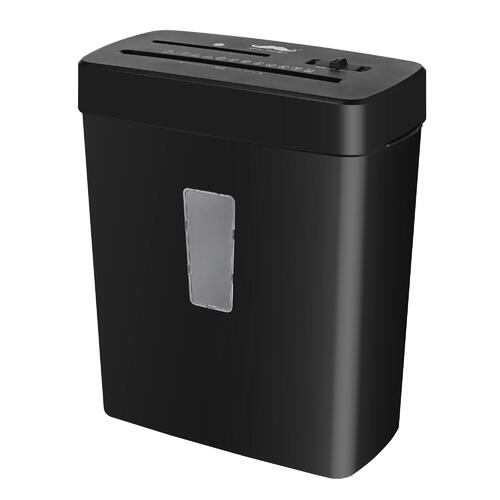
A practical P-4 choice: 8-sheet rating, 13 L bin, approx. 65 dB acoustics, and a simple slide switch. 2 minutes on / 30 minutes off suits short, frequent sessions; supports paper, small staples, and credit cards.
High-Security Super Micro-Cut Shredder
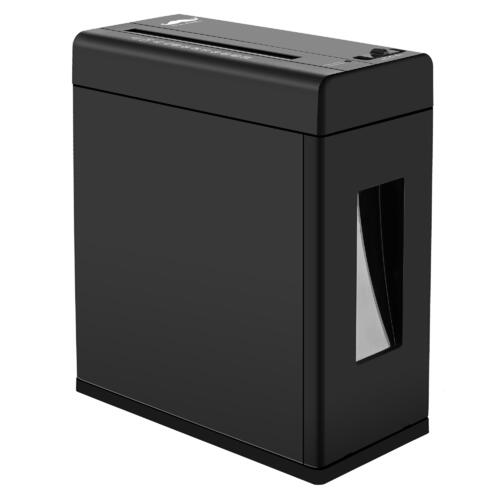
Compact P-5 super micro-cut (≈2×12 mm) with 6-sheet rating and 2.0 m/min speed. Auto start/stop, thermal protection, manual reverse, and a drawer-style bin to minimize mess. Best for “little-and-often” secure shredding. (Source: Internal Product Data, Updated: 2025-12).
Small-Office Micro-Cut Shredder
Fellowes Powershred® LX210 provides micro-cut P-4 security with IntelliBar™ status/efficiency guidance, SafeSense®, a 16-sheet per-pass rating, and a ~6-gallon pull-out bin. Official Fellowes brochures list 20 minutes run / 15 minutes cool-down, micro-cut size 5/32″ × 1/2″, and core dimensions/specifications.
Shredder Specs & Prices (Canada | 2025-12 | CAD)
| Model | Cut Type | Security | Sheets | Bin | Media | Price (CAD) |
|---|---|---|---|---|---|---|
| 5-Sheet Strip Cut Shredder with Extendable Arm | Strip-cut | P-1/P-2 (strip) | 5 | Uses external bin (extendable arm ≤ 35.5 cm) | Paper; forward & reverse jam clear | $24.95 |
| Quiet 8-Sheet Shredder for Homes & Small Offices | Cross/Micro-cut | P-4 | 8 | 13 L | Paper, staples, credit cards | $49.95 |
| High-Security Super Micro-Cut Shredder | Super micro-cut | P-5 (2×12 mm) | 6 | Drawer | Paper | $79.95 |
| Fellowes Powershred® LX210 | Micro-cut | P-4 | 16 | ~6 gal pull-out | Paper, staples, clips, credit cards | $419.99 |
Notes
• Internal pricing is your snapshot; actual prices vary with inventory/promotions.
• Security-level definitions derive from ISO/IEC 21964 and DIN; Canadian public-sector context via the RCMP guide. (Accessed: 2025-12. ISO+2din-de+2)
Canada Shredder Guide: Picking P-4 vs P-5, Runtime and Maintenance
- Map sensitivity to P-level: Most home/SOHO files suit P-4; choose P-5 for higher-sensitivity records (client identifiers, sensitive personal data).
- Match duty cycle to workload: Plan around short continuous run windows on compact units; respect cooldowns to protect the motor and reflect true throughput.
- Media handling & safety: Confirm supported materials in official product documentation; use reverse for minor jams; keep bin from overfilling; observe thermal protection indicators.
OPC Guidance for Shredding: Retention, Destruction and Audit Trails
OPC guidance stresses minimizing collection, defining retention, and disposing of personal information using secure methods—such as shredding—once the purpose is fulfilled. Embed these controls in your written procedures and staff training.
Keep It Running: Jam-Prevention, Bin Hygiene and Thermal Cool-Downs
Stay within sheet ratings; feed square stacks; use reverse to clear minor jams; empty bins before overfill; and respect cool-down windows to extend motor/cutter life. Thermal/overheat protection on compact units reduces heat-related wear.
FAQs: P-4 vs P-5, Runtime Rules, Staples & Cards
Do I need P-5 at home?
For most homes and SOHO, P-4 offers strong privacy. Choose P-5 for higher-sensitivity items (e.g., documents with unique identifiers), accepting lower throughput.
What does “2′ on / 30′ off” mean?
It’s the duty cycle—a short continuous run followed by mandatory cool-down to protect the motor; factor this into real-world throughput planning.
What are my privacy obligations when disposing of paper records?
PIPEDA and OPC guidance expect organizations to implement retention schedules and secure disposal procedures (e.g., shredding) once the purpose is fulfilled.
References & Sources
- Justice Laws — PIPEDA (Principle 4.5.4): destroy/erase/anonymize when no longer required; procedures to govern destruction. Justice Laws
- OPC — Retention & Disposal Guidance (2025-08 update): minimize collection; define retention; securely dispose of PI. Office of the Privacy Commissioner
- OPC — PIPEDA Principles Hub (2025-05): overview of fair information principles. Office of the Privacy Commissioner
- ISO/IEC 21964-1 (Terms & Principles); 21964-2 (Equipment Requirements); 21964-3 (Destruction Process) — “Destruction of data carriers” series. ISO+2ISO+2